Autumn is the one season when a wreath can be made almost entirely from what grows within a mile of your front door. Beech leaves turning copper, rowan berries in tight clusters, rosehips and hawthorn along the same stretch of hedge — all of it wires up beautifully onto a simple mossed ring. Below is a practical guide to gathering those materials sensibly, plus three designs worth making before the first hard frost strips the hedgerows bare.
What Is Worth Picking, and When
Timing matters more than technique. Berries are at their best from late September into October, while there is still plenty left for the birds but before the rain turns them mushy. Leaves hit their peak in mid to late October, and some — beech especially — hold their colour on the branch well into November. A wreath made in the second half of October will usually look good for four to six weeks on a sheltered door.
Look for a mixture of shapes rather than a single material. A hedge that gives you three or four different textures will make a far more interesting wreath than a bag of one thing.
- Beech and oak leaves — coppery, glossy and strong enough to wire without tearing.
- Rowan and hawthorn berries — small, bright and best used in clusters rather than singly.
- Rosehips — glossy red, lovely in odd numbers along the ring.
- Sloes and crab apples — deep purple and gold; use them in small groups.
- Spindle — striking pink and orange capsules, usually on chalky soils.
- Ivy — dark, leathery leaves and black berry clusters for a dense base.
- Seedheads — teasel, honesty, old man's beard and dried allium for texture.
- Moss and lichen-covered twigs — the quiet workhorses that fill gaps and cover wire.
Forage Kindly, and Know What You Are Picking
Pick only from land where you have permission, and only where there is plenty. On a public footpath the hedge is usually the landowner's, so if in doubt, ask. Never dig up plants, never strip a bush bare, and leave the best berries on the branches — they are winter food for birds. Avoid busy roadside verges, land that may have been sprayed, and places where dogs are walked constantly; rinse everything at home in cool water and dry it on a tea towel.
Berries are the part of this project that deserves real care. Several common hedgerow plants carry berries that are harmful if eaten, and yew is the one to know and avoid entirely — the scarlet aril around the seed is easy to confuse with other red berries at a glance. Keep any berry wreath well out of reach of small children and pets, wash your hands after handling, and if you are not certain of an identification, leave it where it is. A reliable field guide or a plant identification app used alongside a book is a sensible double check.
If you cannot name it with confidence, it does not go on the wreath.
Build the Base Before You Gather
A wreath is only as good as its foundation. You need a wire ring of about 25–30cm, a bag of damp moss, a ball of twine, reel wire around 0.56mm, sharp secateurs, and a pair of gardening gloves. Soak the moss for ten minutes and squeeze it out — it should be damp, not dripping.
Work around the ring in one direction only, pressing handfuls of moss against the wire and binding them on tightly with twine. The finished base should be firm enough to hold its shape when you lift it, and roughly as thick as your wrist. This takes fifteen minutes and it is the difference between a wreath that looks generous and one that looks like a bundle of twigs tied to a hoop.
Three Wreaths to Try This Autumn
A Hedgerow Berry Wreath
Start with a mossed ring, then cover it with small bunches of ivy, wired on in the same direction all the way round. Once the base is hidden, add clusters of three or five rowan or hawthorn berries, spacing them evenly and tucking each cluster into the ivy so the wire disappears. Finish with two or three rosehips placed slightly off-centre. Use this one on a sheltered door — berries drop in wind and heavy rain.
A Coppery Leaf Wreath
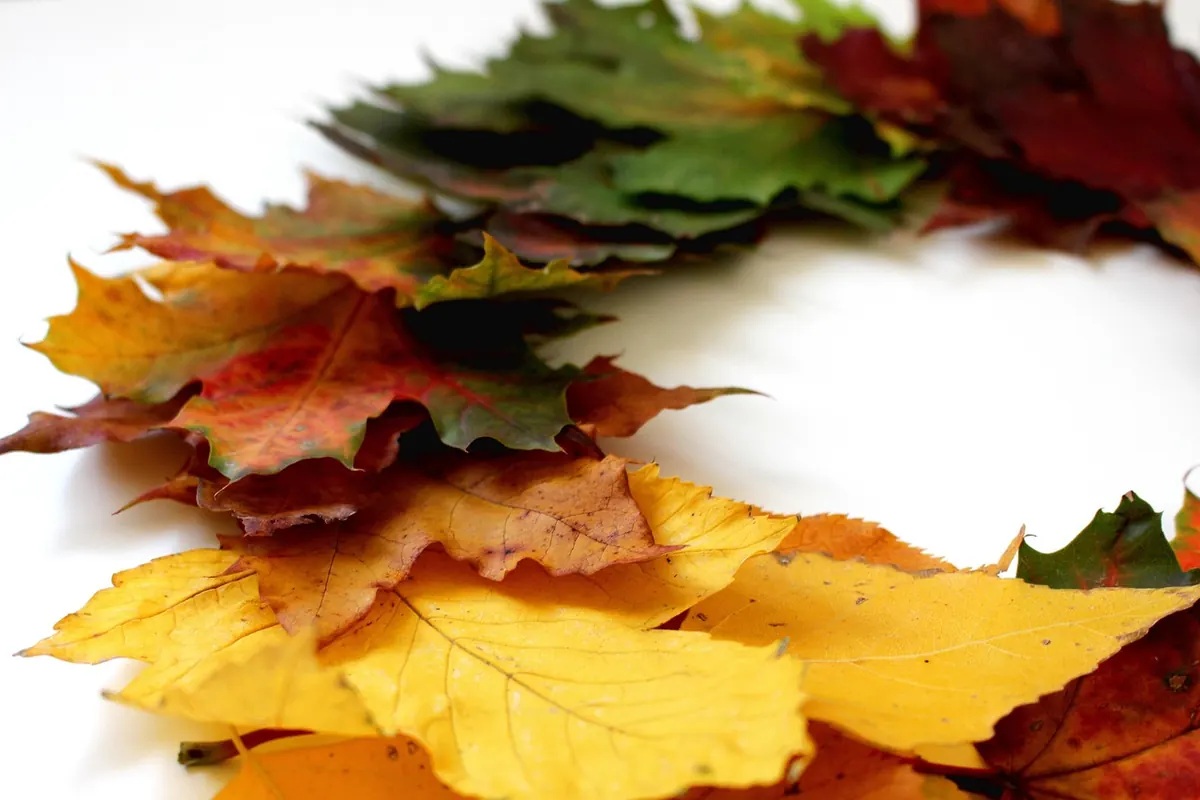
This design suits a front door that faces the weather. Leaves dry out and curl quickly, so preserve them first: stand the stems in a mix of one part glycerine to two parts hot water for a week or two until the leaves feel supple. Then overlap them onto the base like roof tiles, all pointing the same way, working in three thin layers rather than one thick one. Wire through the leaf stem, not the blade. Add a handful of acorns on short wires for contrast, and leave it at that.
A Dry Texture Wreath
Best for a porch or an indoor wall. Gather teasel heads, honesty seed pods, dried hydrangea, old man's beard and a few dried grasses, and wire them onto a base that you have covered with moss and then bound with brown twine. Keep the palette narrow — cream, bronze and grey — and let the shapes do the work. This one will last through to winter if you keep it out of damp.
The Order of Work
- Soak and squeeze the moss, then bind it firmly to the wire ring.
- Add the bulky foliage first, covering the base completely in one direction.
- Fill any gaps with moss, twine or small leaf bundles.
- Add berries and seedheads last, in odd-numbered clusters.
- Hang the wreath on a door and stand back to check the balance before you tidy the wires.
- Cover the back of the ring with a strip of hessian or felt so it does not scratch the door.
Making It Last
Fresh wreaths last longer outdoors than in. If yours is going on an indoor wall, mist it lightly every few days and keep it away from radiators and direct sun. Berries will wrinkle and drop within a fortnight indoors; there is not much you can do about that, so either accept it or use dried berries instead. When the wreath has had its season, unpick the wire, compost the plant material, and keep the ring for next year — it will last for many autumns.
Your First Autumn Wreath
Keep the first one simple. Choose one leaf, one berry and one texture, gather a modest bagful, and give yourself an unhurried afternoon. A mossed 25cm ring, three layers of beech leaves wired in one direction and a scatter of hawthorn clusters will look better than anything overworked. Take a photograph when you hang it, so next October you know exactly what worked.
Photo: Monfocus / Pixabay